
(🇪🇸 Leer la versión en español aquí)
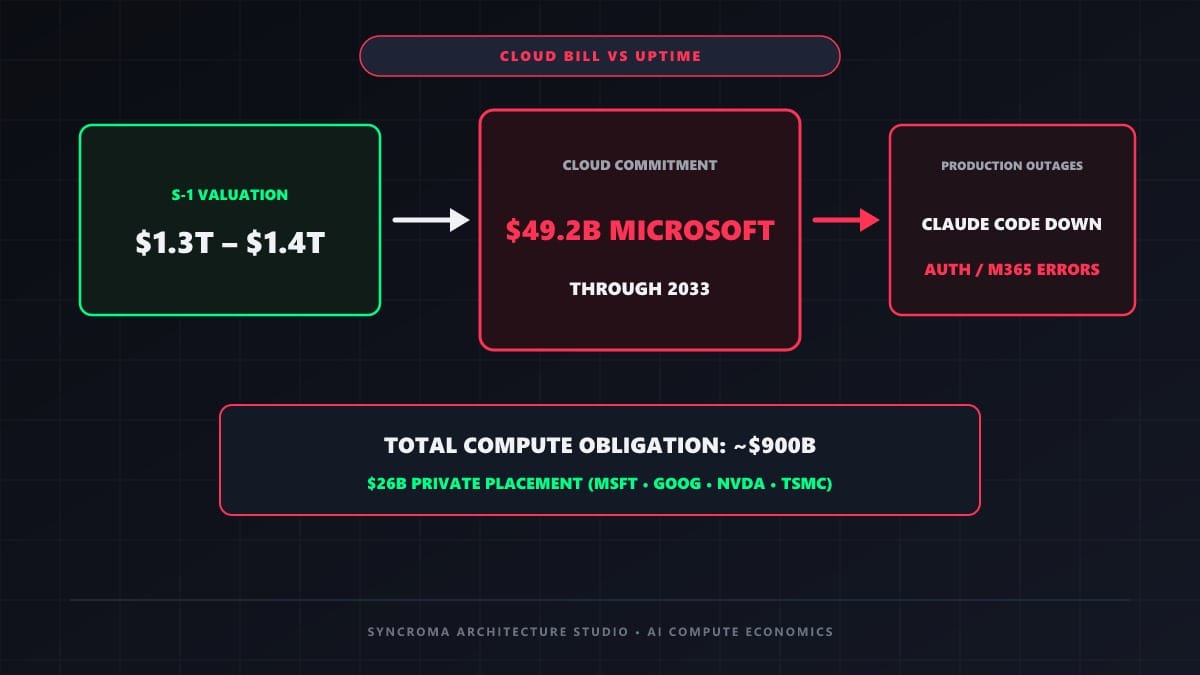
In the same week Anthropic's updated SEC IPO filing revealed infrastructure obligations so massive they bend normal corporate accounting—expanding its Microsoft cloud deal by up to $4.3 billion to reach $47.2 billion–$49.2 billion through June 2033 (Cloud Computing News)—engineers on the ground hit a much more mundane reality: an authentication outage knocked claude.ai offline and partially broke Claude Code (explainx.ai, Claude Status).
Taken together, the two headlines expose the real tension in modern AI engineering: monumental multi-year silicon bets colliding with brittle everyday control planes.
Inside the S-1 Filing: ~$900.9 Billion in Compute Commitments
According to the amended SEC filing submitted November 10, 2026 and detailed by Cloud Computing News, Anthropic now carries roughly $900.9 billion in aggregate spending commitments—almost all for compute and data centers, excluding an estimated $150B–$175B in uncapped infrastructure agreements:
| Infrastructure Partner | Committed Spend / Range | Contractual Terms & Production Reality |
|---|---|---|
| Microsoft (Azure) | $47.2B – $49.2B (+$4.3B added Nov 2026) | Runs through June 2033; non-cancellable minimum regardless of actual utilization (Cloud Computing News). |
| Google Cloud (+ TPUs) | At least $121.3B hosting + extra TPU buys | April 2026 – July 2033; requires capacity reservations 12–18 months ahead (Cloud Computing News). |
| Amazon (AWS) | Minimum $110B | May 2026 – April 2036 under minimum take-or-pay terms (Cloud Computing News). |
| Neoclouds (SpaceXAI, Nscale, Lambda) | $120.5B max (SpaceXAI), ~$44.6B (Nscale), $41.3B (Lambda) | Tied to delivered capacity; a $34.9B Lambda lease missed a deadline, making it terminable (Cloud Computing News). |
The quarterly burn shows why AI unit economics stay razor-thin: Anthropic spent $18.8 billion on compute and infrastructure during the first nine months of 2026 (up from $4.4 billion a year earlier), jumping from $944 million in Q1 2025 to $9.9 billion in Q3 2026 alone (Cloud Computing News). An estimated $451.6 billion of its total commitments falls due before the end of 2030.
Meanwhile in Production: Taken Out by Auth
Even backed by nearly a trillion dollars in cloud contracts, developers leaning on Claude Code suffered two separate reliability hits inside 48 hours (explainx.ai, Claude Status):
- Upstream Microsoft 365 blast radius (Nov 12–13): When Microsoft's Exchange Online
EX1550543incident melted down mail and Graph APIs, Anthropic's M365 connectors failed for mail, calendar, and search requests. - Standalone authentication failure (Nov 13, 09:58 UTC): Unrelated to Microsoft, identity and session establishment broke—pushing
claude.aiinto a Major outage and forcing Claude Code andplatform.claude.cominto Partial outage until engineers deployed a fix under monitoring at 11:05 UTC.
Notice the telling architectural split noted by explainx.ai: headless Claude API inference stayed operational while interactive web sessions and IDE/CLI developer paths slammed into the auth gateway.
What Engineering Teams Should Take Away
The S-1 filings and the status-page churn deliver three practical rules for teams building on frontier models:
- Decouple CI/CD and agent tooling from interactive OAuth flows: Keep stateless API-key paths and thin multi-provider abstractions ready so an auth-layer hiccup on a vendor web console doesn't stall sprint velocity.
- Expect relentless pricing and quota pressure through 2030: With $451.6 billion in infrastructure obligations hitting before 2030, token efficiency, caching, and ruthless context trimming aren't optional optimizations—they protect your burn rate.
- Avoid single-vendor workflow lock-in: Anthropic itself spreads risk across Azure, GCP, AWS, specialist GPU hosts, and self-leased Anthropic Direct data centers. Your engineering stack deserves the same fallback discipline.
Visuals and layout by Syncroma Studio.
Sistemas reales, sin humo corporativo Real systems, zero corporate hype
Recibe los análisis a fondo sobre arquitectura, consumo de recursos y computación de bajo nivel directamente en tu bandeja de entrada. Get deep-dive software architecture, resource consumption metrics, and low-level computing essays delivered straight to your inbox.
Suscribirse a Syncroma Subscribe to Syncroma

