(🇪🇸 Leer la versión en español aquí)
For years, mobile privacy pitches followed one tidy rule: run every SMS classifier strictly on-device so message bodies never leave your phone. Unfortunately, tiny local models constrained by mobile RAM and thermal budgets struggle to catch modern multi-week fraud scripts. That is why Google just launched an opt-in Enhanced Protection tier in Google Messages that routes conversations from unknown senders to cloud Gemini models running inside Private AI Compute, announced on Google’s Security Blog and detailed by TechRepublic and Unite.AI.
The shift targets so-called slow-burn scams: fraudsters no longer drop an obvious phishing URL in message one. Instead, they groom targets across days of polite small talk before steering them into fake investments or bank impersonations — multi-turn conversational patterns too broad for lightweight single-message on-device filters.
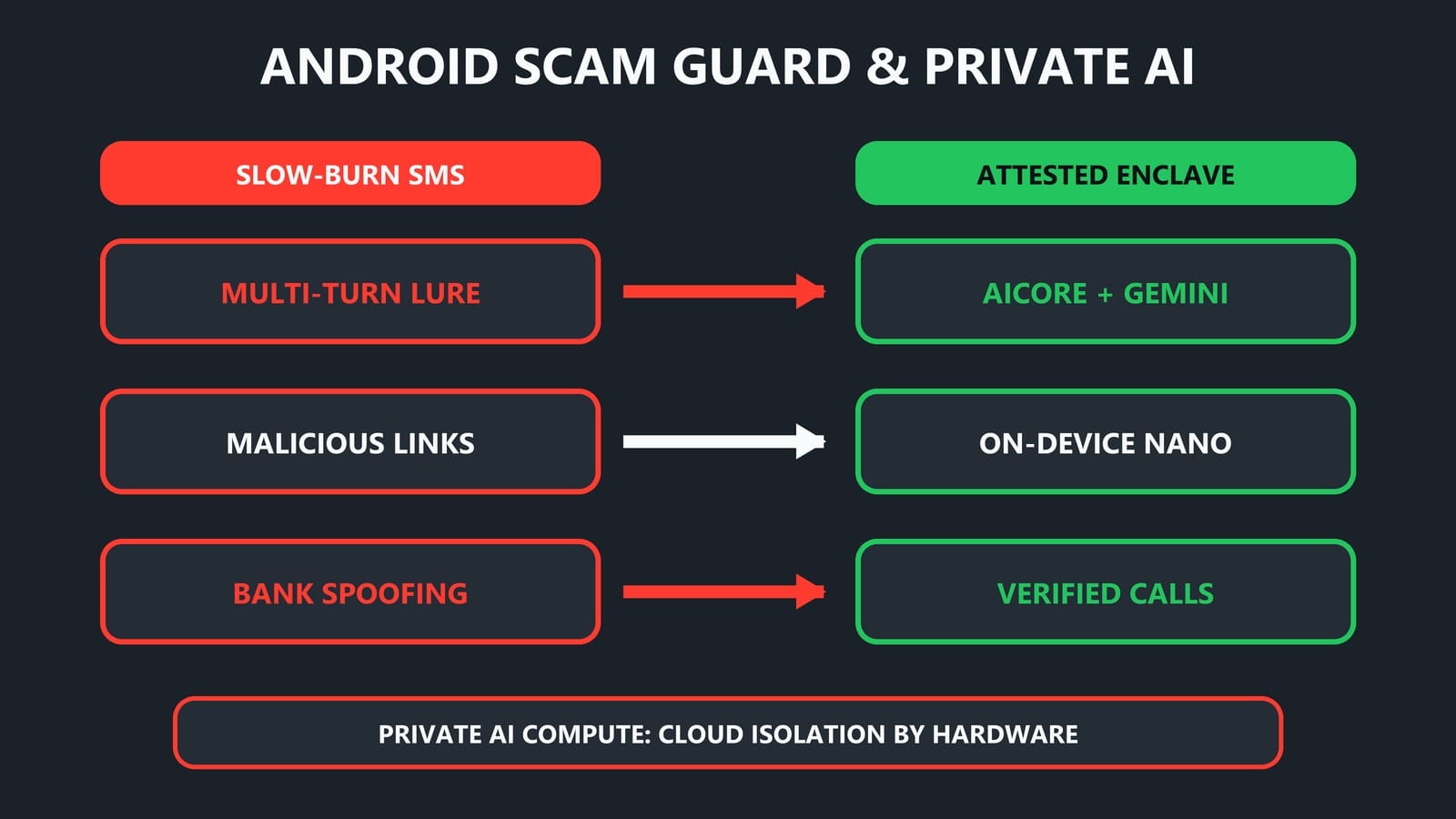
On-Device Gemini Nano vs. Cloud Private AI Compute: Where Each Check Runs
Android’s updated security stack splits detection across device silicon and attested cloud enclaves depending on the threat surface and hardware tier:
| Protection Layer | Execution Boundary | What It Inspects | Supported Hardware / Scope |
|---|---|---|---|
| Standard Scam & Link Checks | On-device (AICore + Gemini Nano) |
Known scam signatures & suspicious links | Eligible AICore / newer Gemini Nano devices per Tbreak |
| Enhanced Protection (opt-in) | Isolated cloud (Private AI Compute) | Multi-turn context from unknown senders | Pixel 6+, Galaxy S24+, Z Flip 6 / Fold 6+ via AICore per TechRepublic |
| Screen-Share & Bank Call Guard | Android OS + participating banks | Chrome/WebView hiding during screen share & verified bank calls | Cross-OEM notification alerts, call-forwarding guards & banks per Google Security Blog |
From a security-architecture angle, the core guarantee behind Private AI Compute is hardware-isolated execution: encrypted conversation state is processed inside a dedicated enclave designed so neither third parties nor Google itself can inspect user messages or retain them for model training.
No-BS Engineering Reality: What You Gain and What Trust Model Changes
- Remote attestation is still a trust boundary: an isolated cloud enclave keeps plaintexts out of ordinary logs, yet enterprise compliance teams handling NDA or regulated data still have to trust the vendor’s hardware attestation chain and enclave implementation — which is why making Enhanced Protection opt-in matters.
- Thermal & RAM physics forced the hybrid split: holding multi-day conversation windows in RAM inside a background daemon whenever an SMS arrives would chew through mobile memory and battery fast. Offloading unknown-sender multi-turn analysis to cloud TPUs trades strict air-gapping for much higher recall against AI-generated social engineering.
- Practical non-AI guardrails may save more accounts: masking sensitive Chrome/WebView banking tabs during active screen-sharing calls and pairing verified bank caller IDs attacks the exact phone-coach script fraudsters rely on today. Whenever you want to inspect suspicious SMS URLs or hidden zero-width lures locally first, run them offline through our URL UTM cleaner & Punycode phishing inspector or invisible Unicode cleaner.
Practical Checklist for Android Users & Mobile Fleet Admins
- Verify opt-in preferences on managed Android devices: confirm whether Google Messages’ cloud Enhanced Protection tier aligns with your organization’s data-handling rules on Pixel 6+ and Galaxy S24+ fleets.
- Pair anti-scam alerts with hard financial rules: remind family and staff that real banks never ask customers to enable remote screen sharing or read back SMS OTP codes while on a live voice call.
- Never rely on legacy SMS as confidential transport: carrier SMS remains cleartext long before hitting Android’s
AICore; encrypt sensitive secrets client-side with tools like our offline AES-256-GCM encryptor.
Mobile OS security just conceded an uncomfortable reality: small local models alone can no longer outthink patient, AI-assisted social engineers — pushing the privacy boundary straight into hardware-attested cloud enclaves.
Credits: Syncroma Studio. Cover photo: Samsung Galaxy S24 series (Wikimedia Commons, CC BY 3.0); original editorial infographic by Syncroma Studio.
Sistemas reales, sin humo corporativo Real systems, zero corporate hype
Recibe los análisis a fondo sobre arquitectura, consumo de recursos y computación de bajo nivel directamente en tu bandeja de entrada. Get deep-dive software architecture, resource consumption metrics, and low-level computing essays delivered straight to your inbox.
Suscribirse a Syncroma Subscribe to Syncroma

