(🇪🇸 Leer la versión en español aquí)
There is a comforting bedtime story Google's marketing teams love to tell: the idea that Android’s layered security architecture—process isolation via Linux UIDs, mandatory access controls in SELinux, and sandboxed runtimes—makes modern smartphones virtually immune to remote zero-click compromise. You are told that attackers must always rely on social engineering: tricking an end user into clicking a link, downloading an APK, or granting runtime permissions.
In the engineering trenches of production systems, reality is far more unforgiving.
In the official November 2026 Android Security Bulletin published on the Android Open Source Project (AOSP) portal, Google quietly patched over 200 vulnerabilities across the OS stack. Standing at the top of the advisory with a critical severity rating is a flaw cataloged in the NIST NVD database as CVE-2026-58868: an unauthenticated, zero-click Remote Code Execution (RCE) vulnerability residing directly within Android’s native media extraction and decoding framework.
No downloads required. No permissions prompted. No screen interactions needed. Merely delivering a crafted multimedia frame to a vulnerable device can compromise native heap memory.
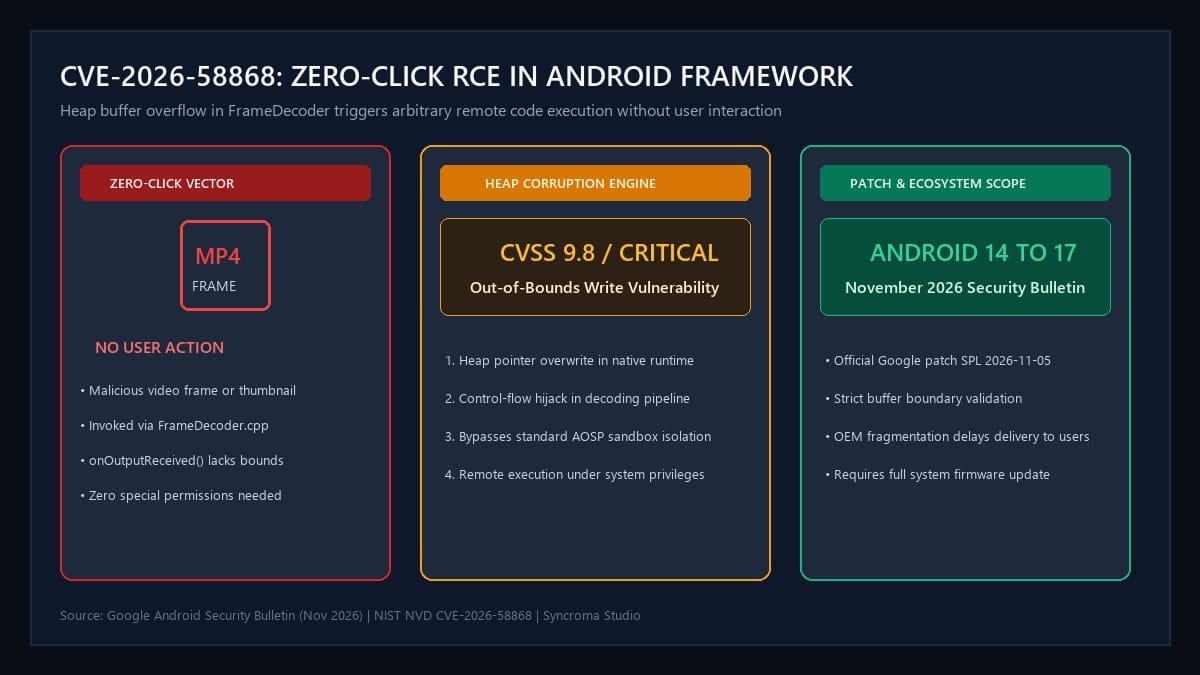
Root Cause Analysis: FrameDecoder.cpp and onOutputReceived
To understand how a silent background notification or automatic thumbnail generation can hijack an entire operating system, you have to look into the native C++ layers of Android's media framework (libstagefright and the decoding components under /frameworks/av/).
Whenever an application receives an image stream, short video snippet, or rich media attachment (via RCS, WhatsApp, MMS, or browser background pre-rendering), the operating system delegates keyframe extraction to FrameDecoder.cpp. The core processing pipeline executes onOutputReceived to accept raw frame buffers delivered by the underlying hardware or software video codec.
The fundamental flaw in CVE-2026-58868 is a textbook C++ memory corruption bug: a heap buffer overflow resulting in an arbitrary Out-of-Bounds Write:
- Flawed Stride and Dimension Calculations: When parsing crafted metadata from an incoming video frame with malformed color strata or non-standard aspect ratios, the function calculates a destination heap buffer allocation smaller than the raw payload delivered by the decoder.
- Unchecked Memory Copy: During byte copying into the allocated memory region, the routine fails to enforce strict boundary validation (
bounds check). Excess bytes spill over adjacent control blocks inside thejemalloc/scudoheap allocator. - Control-Flow Hijack: By corrupting heap metadata and overwriting virtual method table (
vtable) pointers, an attacker redirects the CPU’s program counter (PC/IP) to execute arbitrary shellcode injected into the process address space.
Because background indexing daemons and notification handlers automatically generate preview thumbnails upon receiving media packets over cellular or Wi-Fi connections, exploitation happens silently. It is the archetypal zero-click attack vector.
The Sandbox Breakdown: Escalating from mediaserver to system_server
Security evangelists often claim that media vulnerabilities are harmless because decoding happens inside unprivileged sandbox processes like mediaserver or mediacodec, tightly contained by SELinux domains. In real-world enterprise devices, that defense is porous:
- Framework-Level Execution Context: CVE-2026-58868 directly impacts framework components that interface with core system services (
system_server). If the overflow is triggered in the context of system window rendering or package management previewing, the injected code executes with UIDsystem(1000). - Direct IPC Access via Binder: Once code execution is established inside a system-level media component, an attacker can dispatch Binder IPC transactions to internal system interfaces, completely bypassing Android's runtime permission dialogues. The attacker gains unrestrained access to the camera, microphone, local storage, GPS coordinates, and outbound socket connections.
With a base CVSS score of 9.8 out of 10, this is not an academic edge case; it represents a ready-made entry point for commercial zero-click spyware toolkits like Pegasus and Predator.
The Fragmentation Bottleneck: Why the Patch Won’t Reach Most Users
Google deployed the official fix in the 2026-11-05 Security Patch Level (SPL), covering Android versions 14, 15, 16, and 17.
If you own a Google Pixel, your device likely applied the OTA update in the background days ago. However, for the hundreds of millions of developers, engineers, and everyday users carrying devices from Samsung, Xiaomi, Motorola, Oppo, or generic OEM manufacturers, the reality is dictated by the slow grind of the Android supply chain:
| Device Tier | Average Patch Delivery Timeline | Exposure to CVE-2026-58868 |
|---|---|---|
| Google Pixel (Direct AOSP) | 0 to 48 hours | Patched in SPL 2026-11-05 |
| Flagship Tier (Samsung Galaxy S / Ultra) | 2 to 4 weeks | In carrier testing & validation |
| Mid-Range / Budget (Redmi, Galaxy A, Moto G) | 2 to 4 months | Actively exposed in the field |
| Industrial Tablets & Android PoS Terminals | 6 to 12 months (or abandoned) | Permanently vulnerable |
OEMs cannot simply cherry-pick FrameDecoder.cpp. They must merge the AOSP diffs into their heavily customized skins (One UI, HyperOS, etc.), run comprehensive CTS/VTS regression suites, and submit carrier builds through protracted regional validation gauntlets.
During that multi-month delay, billions of mobile devices in active service remain wide open to silent remote compromise.
Engineering Verdict
CVE-2026-58868 lays bare the structural weakness of the Android ecosystem: regardless of how many modern Kotlin frameworks or sandboxing layers you build on the surface, the low-level media parsing engines still rely on legacy C/C++ native code where a missing bounds check means immediate remote compromise. Until Google finishes migrating all core framework parsers to memory-safe languages like Rust, Android will remain perpetually vulnerable to zero-click attacks where parsing a single video frame surrenders total system control.
Infographic and research credits: Syncroma Studio.
Sistemas reales, sin humo corporativo Real systems, zero corporate hype
Recibe los análisis a fondo sobre arquitectura, consumo de recursos y computación de bajo nivel directamente en tu bandeja de entrada. Get deep-dive software architecture, resource consumption metrics, and low-level computing essays delivered straight to your inbox.
Suscribirse a Syncroma Subscribe to Syncroma

